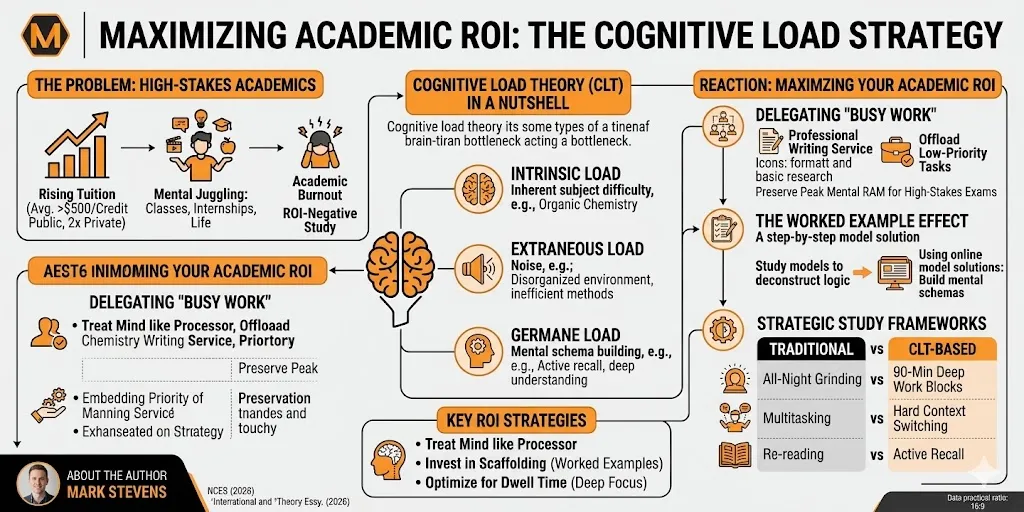
The American higher education landscape is currently navigating a cost-of-living crisis that has transformed the pursuit of a degree into a high-stakes financial calculation. With the rising cost of tuition per credit hour now averaging over $500 at public four-year institutions (and doubling that at private universities), US students are no longer just “learning”—they are investing.
To maximize the Return on Investment (ROI) of a degree, students must move beyond the “hustle culture” of all-nighters and adopt a strategy rooted in educational psychology: Cognitive Load Theory (CLT). By understanding how the human brain processes information, you can stop the cycle of academic burnout and start treating your mental energy as your most valuable asset.
The Economics of the Mind: What is Cognitive Load?
Developed by John Sweller, Cognitive Load Theory suggests that our working memory acts as a bottleneck. Think of your brain like a high-end laptop with limited RAM. If you try to run too many heavy applications at once—calculating complex equations, worrying about a 2026 internship application, and managing a social calendar—the system freezes.
In an academic context, cognitive load is divided into three categories:
- Intrinsic Load: The inherent difficulty of the subject (e.g., Organic Chemistry vs. Basic Sociology).
- Extraneous Load: The “noise” created by disorganized study environments or inefficient methods.
- Germane Load: The actual “work” of building long-term mental schemas.
To maximize your academic ROI, the goal is simple: Eliminate extraneous load, manage intrinsic load, and maximize germane load.
Delegating the “Busy Work” to Protect Your Mental RAM
For the modern US student, the challenge isn’t just the curriculum; it’s the juggling act. Whether you are balancing Greek life responsibilities with a rigorous STEM major or trying to maintain a 4.0 GPA while working a 20-hour-a-week internship, your “cognitive RAM” is constantly under siege.
High-achieving students are increasingly viewing their education through a managerial lens. Utilizing a professional homework writing service is no longer just a “safety net”—it is a strategic decision to offload high-volume, lower-priority tasks. In a world where a single credit hour can cost a week’s wages, spending five hours on repetitive formatting or basic research for a secondary elective is an ROI-negative move. Delegating these tasks allows you to preserve your peak mental hours for high-stakes exams and core-major projects that directly impact your career trajectory.
Data-Driven Study: Why “Brute Force” Learning Fails
Recent data indicates that the “switching cost” of multitasking reduces productivity by as much as 40%. For US students, this often manifests as “study-blur”—where six hours are spent in the library, but only one hour of actual deep learning occurs.
The “Worked Example” Effect
Research in the Journal of Educational Psychology shows that for complex STEM subjects, studying a completed solution is often more effective than “productive struggle” for beginners. This is because “struggling” increases extraneous load, whereas a model solution allows the brain to focus on the logic of the steps (Germane Load).
Many students choose to do my homework online specifically to acquire these “Worked Examples.” By using professionally structured solutions as a study guide, you can work backward to deconstruct the logic, building the mental schema required to solve similar problems independently during midterms.
Strategic Study Frameworks for 2026
| Traditional Method | CLT-Based Method (High ROI) | Why it Works |
| Re-reading Textbooks | Active Recall / Scaffolding | Re-reading creates an “illusion of competence” but adds no germane load. |
| All-Night Grinding | 90-Minute “Deep Work” Blocks | Sleep deprivation causes a 30% drop in working memory capacity. |
| Multitasking (Greek Life/Study) | Hard Context Switching | Batching social/admin tasks separately prevents “attention residue.” |
Key Takeaways
- Treat Your Mind Like a Processor: Stop overtaxing your working memory with low-value administrative tasks.
- Invest in Scaffolding: Use model assignments and expert guides to lower the intrinsic load of difficult STEM subjects.
- Optimize for Dwell Time: Deep focus on one subject for 90 minutes provides a higher ROI than four hours of distracted study.
- ROI > Grades: Focus on the knowledge you can actually apply in the competitive 2026 job market.
FAQ Section
Q: Does Cognitive Load Theory apply to non-STEM majors?
A: Absolutely. Whether it’s Law, Nursing, or Business, any field with complex terminology and dense regulations requires schema-building to move information into long-term memory.
Q: Is “outsourcing” assignments ethical?
A: When used as a pedagogical tool—such as a “Worked Example” or a research baseline—it is a standard part of modern academic strategy, similar to using a tutor or an AI research assistant.
Q: How can I reduce “Extraneous Load” immediately?
A: The fastest way is “Environment Scrubbing.” Turn off phone notifications and use one screen only. Every “ping” takes approximately 23 minutes to fully recover your focus from.
About the Author: Mark Stevens
Kara Betty is a Senior Academic Strategist at MyAssignmentHelp, where he specializes in curriculum alignment and student productivity frameworks. With a background in educational psychology, Kara has helped thousands of US students navigate the complexities of STEM degrees and competitive internships.
Connect with Kara Betty: View Professional Bio & LinkedIn
References
- Sweller, J. (2025). Cognitive Load Theory: Principles and Applications in Digital Learning.
- NCES (2026). The Rising Cost of US Higher Education: A Credit-Hour Analysis.
-
Newport, C. (2023). Deep Work: Rules for Focused Success in a Distracted World.
