
Walk into any UK vape shop in 2026 and the choice is genuinely bewildering. Puff counts have climbed into the tens of thousands, half the brands on the shelf did not exist three years ago, and every box promises the smoothest hit and the best flavour. For someone who just wants to stop smoking, or who simply wants their next device to be better than their last, it is a lot of noise to cut through.
The good news is that choosing well comes down to five decisions, and most of them are easier than the marketing suggests. This guide walks through each one in order, explains what actually matters, and flags the things that sound important but really are not.
First, understand what changed
It is worth knowing why the market looks the way it does. When the UK banned single-use disposable vapes in June 2025, an enormous category vanished overnight. Millions of people who had settled into a simple habit, buy a bar, use it, bin it, suddenly needed something else.
Manufacturers responded with rechargeable prefilled pod kits: devices that feel almost identical to the old disposables but keep the battery and swap only the pod. That is why so much of what you see now is described as a prefilled kit, and why the puff counts are so much higher. One pod pack has to last where a whole disposable used to. Understanding that shift explains most of what is on the shelf today.
The five decisions that matter
1. Prefilled or refillable?
This is the big fork in the road, and it comes down to how much involvement you want. Prefilled pod kits are the closest thing to the old disposable experience. You buy a pod, click it in, vape it, and swap it when it is done. There is nothing to measure, no bottles, no coils to fit. If you want something that simply works, this is the category for you.
Refillable kits ask a little more. You buy e-liquid separately, fill the pod yourself, and replace a coil every week or two. In exchange you get the widest possible flavour choice and by far the lowest running cost, often less than half what prefilled works out at. Neither option is better in the abstract. Be honest about whether you will actually enjoy the small ritual of refilling, or whether you would rather not think about it at all.
2. Get the nicotine strength right
More people get this wrong than anything else, and it is the difference between a switch that sticks and one that quietly fails. In the UK, nicotine e-liquid is capped at 20mg per millilitre, which is the same as 2 percent. Within that limit, the honest starting point is your old smoking habit.
A heavy smoker, or anyone coming straight from cigarettes or from a disposable, will usually want 20mg, since almost every disposable ran at that strength. A moderate smoker on around ten a day tends to land comfortably at 10mg. A light or social smoker will often find 5mg is plenty. Almost all of these liquids use nicotine salts, which are absorbed quickly and stay smooth even at high strengths, so a 20mg salt feels far gentler than the number suggests.
Then pay attention to your body. A head rush, a scratchy throat or slight nausea means you have gone too strong, so drop a level. Vaping constantly without ever feeling settled usually means you have gone too weak. Most people find their level within a week or two of small adjustments, and there is no prize for starting higher than you need.
3. Be realistic about puff counts
Puff count is the number the industry shouts loudest about, and it is the one most worth treating with a bit of scepticism. Those figures are laboratory estimates based on short, gentle draws. If you take longer, harder pulls, and most ex-smokers do, your real-world total will be meaningfully lower.
More useful is to think in weeks. A 6,000-puff pod tends to last a moderate vaper around a week. A 20,000 or 25,000-puff device might stretch to a month. Bigger is not automatically better, either: high-capacity devices cost more up front, are usually bulkier, and if you are still settling on a flavour you may find yourself stuck with a great deal of something you have gone off. For a first device, something in the 6,000 range is a sensible, low-risk place to start.
4. Flavour is personal, so start broad
Flavour is what keeps people off cigarettes, and it is worth taking seriously. The categories are straightforward: fruits, iced and menthol blends, drinks and sodas, sweets and desserts, and tobacco. Where people go wrong is buying three variations of the same thing before they know what they actually like on a device.
A better approach is to start with two contrasting pods, typically one fruit and one menthol, and see which you reach for. Many people also find they want different things at different times of day, something sharp in the morning and something sweeter in the evening. A few devices now hold two flavours at once and let you switch between them, which is a genuinely useful feature if you already know you get bored of a single taste.
One practical note: tobacco flavours rarely taste like cigarettes, and expecting them to is a common disappointment. Most long-term switchers end up on fruit or menthol, even if they were sure they would not.
5. Work out the real running cost
Sticker price tells you very little. What matters is what the device costs you per week once you are actually using it, and that depends on the price of pods or e-liquid, how much you vape and how long each pod lasts. A cheap kit with expensive pods can easily cost more over a month than a pricier kit with cheap refills.
This is worth five minutes of arithmetic before you buy, because the differences are larger than most people expect. If you would rather not do it by hand, there are free tools that will do it for you: this vape cost calculator compares what you are spending now against a refillable setup and shows the weekly and annual difference. For anyone coming off a heavy disposable habit, the numbers are usually eye-opening, and they make the case for a reusable device far better than any product description.
Things that matter less than you think
A few specifications get far more attention than they deserve. Battery capacity in mAh sounds important, but almost any modern pod kit will comfortably last a day, and they all charge over USB-C in under an hour, so the difference rarely shows up in real use. Coil resistance and wattage matter enormously on large, powerful mods, but on a simple mouth-to-lung pod kit these are preset and you will never touch them.
Brand loyalty is another one. The gap between the major names is much narrower than the marketing implies; most use similar mesh coil technology and similar nicotine salt formulations. Flavour range and pod price usually separate them more than any technical specification does. And screens, while pleasant, are a convenience rather than a reason to choose one device over another.
Puff-count arms races fall into the same bracket. A device advertising fifty thousand puffs is not five times better than one offering ten thousand; it simply holds more liquid and asks you to commit to a single flavour for much longer. Unless you vape heavily and already know exactly what you like, the extra capacity often works against you. Judge a device on how it feels to use and what the refills cost, and you will make a better decision than any spec comparison would give you.
Where to do your research
Once you know roughly what you want, comparing specific products is the last step, and it is worth using a source that lines devices up on the same criteria rather than reading a series of product pages that each claim to be best. Retailer-run comparison and buying guides can be useful here, provided they rank from stock they actually carry and compare on consistent measures like puffs, price and flavour rather than simply listing whatever they most want to shift.
Independent reviews and user forums are worth a look too, though take individual flavour opinions with a pinch of salt; taste is the most subjective thing about vaping, and a flavour one person calls sickly another will vape all day. What you should look for in any source is whether it tells you when not to upgrade. Advice that occasionally says your current device is fine, or that a problem is a two-minute fix rather than a reason to buy something new, is generally advice worth trusting.
A quick word on buying safely
Wherever you shop, stick to established UK retailers. Everything sold legally here must be TPD compliant and registered with the MHRA, which means nicotine strength capped at 20mg, e-liquid bottles limited to 10ml and tanks limited to 2ml. If you see a UK listing advertising 50mg nicotine or enormous tank capacities, that is a clear sign the product is not compliant and is best avoided.
Buying from a proper retailer also means you get genuine stock rather than counterfeits, which have been a persistent problem with the most popular brands. Established shops such as Pink Vape source from UK distributors and carry the matching refills, which matters more than it sounds: nothing is more frustrating than settling on a device and then struggling to find pods for it three weeks later.
Putting it together
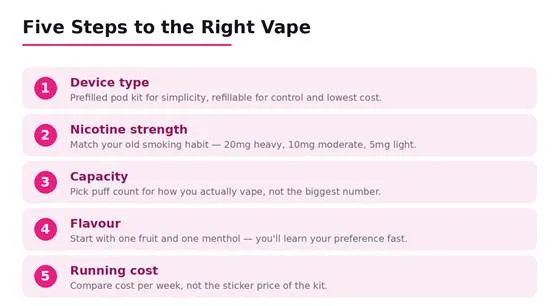
If you want the short version: decide whether you would rather refill or simply swap a pod, pick your nicotine strength from your old smoking habit, choose a modest capacity for your first device, buy two contrasting flavours rather than three similar ones, and check the weekly cost before you commit. That will get the great majority of people to a device they are still happy with in three months.
Above all, do not overthink the specifications. Vaping is one of the few purchases where the cheapest sensible option is very often the right one, and where the main thing standing between you and success is getting the nicotine level right rather than owning the most impressive device. Start simple, adjust as you learn, and let your own experience rather than the packaging tell you what works.