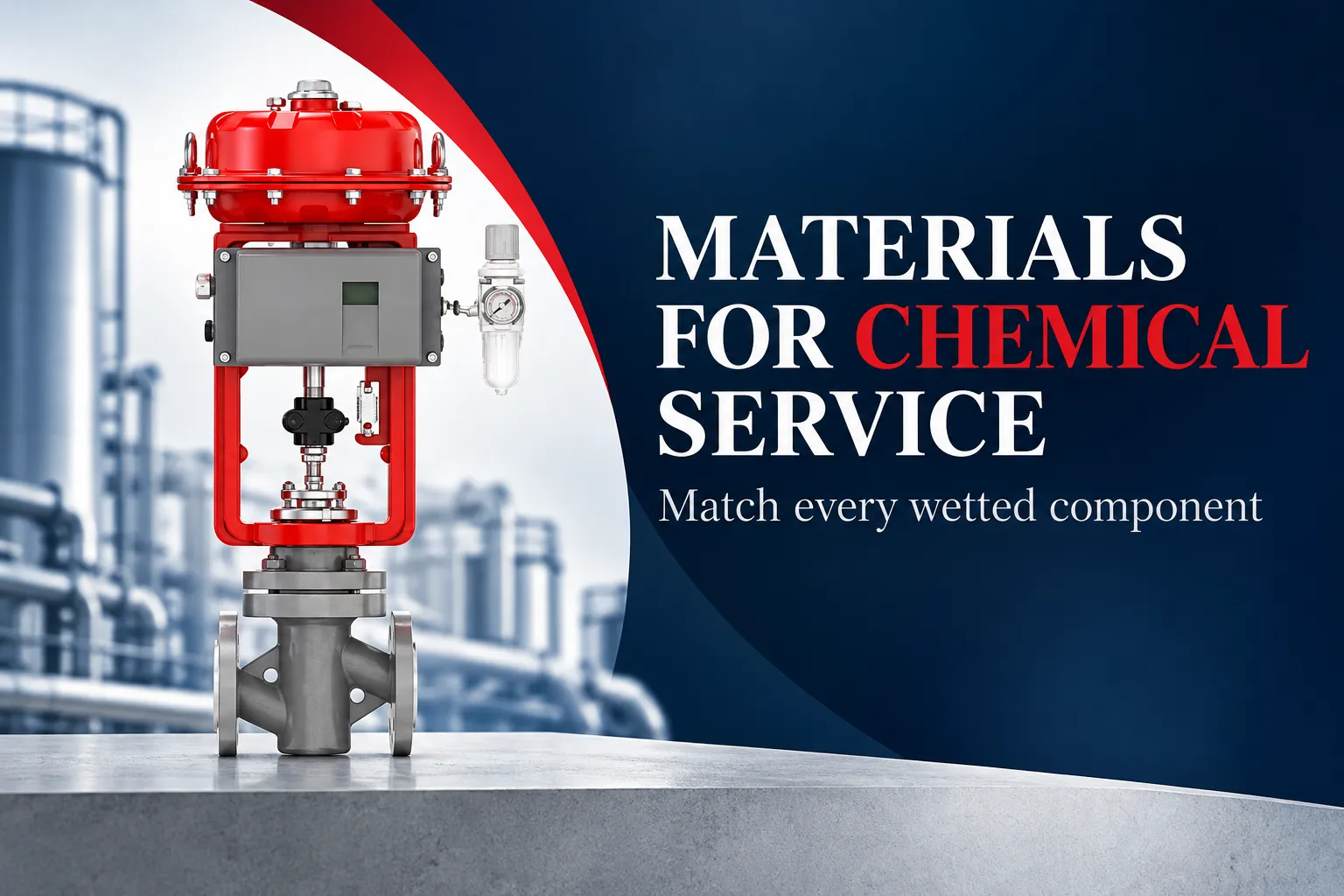
Control valves for chemical processing need materials selected for the combined chemical, thermal, and mechanical duty. The fluid’s name is only the beginning. Concentration, temperature, contaminants, particles, pressure drop, and cleaning exposure can change which body, trim, lining, and sealing materials are appropriate.
The most useful selection separates the damage mechanisms. Corrosion is not the same as erosion, and chemical compatibility does not establish resistance to cavitation or repeated movement. A material upgrade should address an identified mechanism rather than simply replace one familiar alloy with a more expensive one.
Describe the whole fluid exposure
Record the principal chemicals and their concentration ranges. Include water content, contaminants, and any expected changes during production. A fluid description that is accurate only at one operating stage may miss the condition that governs material suitability.
Temperature belongs beside the composition. Compatibility information at ambient temperature may not describe the same chemical at an elevated process temperature. If the line is cleaned or flushed with another medium, include that exposure and the sequence in which it occurs.
Also identify whether the stream is liquid, gas, or potentially mixed phase at the valve. A liquid upstream can behave differently after pressure reduction. The selection needs the state at relevant operating conditions, not just the state in a storage vessel or laboratory sample.
Review every wetted component
The body contains the pressure, but it is not the only component exposed to the fluid. Plug, seat, cage, stem, packing, body gaskets, and secondary seals may use different materials. A suitable body alloy does not establish that the complete assembly is compatible.
Moving interfaces deserve particular attention. The stem packing must seal while allowing movement, and the trim must maintain its intended geometry under flow and contact loads. A material that resists the chemistry may still be unsuitable for the mechanical role it is asked to perform.
When comparing control valves for chemical processing, ask how the proposed material combination fits each function. This produces a clearer discussion than requesting a valve described broadly as “corrosion resistant” without identifying which components or exposure the phrase covers.
Separate corrosion from mechanical wear
Corrosion involves interaction between the material and its environment. Erosion involves material removal associated with moving fluid or particles. They can occur together, but selecting for one does not automatically resolve the other.
For a particle-bearing stream, identify particle size, hardness, concentration, and the possibility of settling or deposits. Fine soft particles behave differently from hard angular grit. The local velocity around the control restriction can also be more demanding than the average velocity in the connected pipe.
For illustration, a chemically mild liquid containing abrasive particles may require a different trim assessment from a clear corrosive liquid. The first case emphasizes wear mechanisms; the second emphasizes compatibility. A real stream can combine both, requiring a construction that addresses the combined duty.
Pressure reduction can change the material problem
The valve creates a restriction that changes fluid velocity and local pressure. In liquid service, vapor formation and subsequent collapse can contribute to cavitation damage. If vapor persists after the valve, flashing introduces a different flow condition. These mechanisms cannot be identified from body material alone.
Pressure, temperature, vapor pressure, and the valve’s recovery behavior help determine the relevant assessment. A harder trim surface may improve resistance to a particular damage mechanism, but it does not remove the pressure conditions that produce it.
This is why repeated internal damage should prompt a review of the operating case and flow path, not only a search for a stronger alloy. The appropriate response may involve trim geometry, pressure staging, or a different process arrangement as well as materials.
|
Service influence |
Material or construction question |
Common oversimplification |
|---|---|---|
|
Chemical concentration |
Which wetted materials tolerate the range |
Selecting from chemical name alone |
|
Temperature |
Does compatibility remain acceptable |
Using only room-temperature data |
|
Particles |
What resists the actual wear mechanism |
Treating all dirty fluids alike |
|
Pressure drop |
Is the trim suited to fluid behavior |
Assuming hard material removes cavitation |
|
Cleaning |
What changes during intermittent exposure |
Reviewing production fluid only |
|
Movement |
Can seals function while cycling |
Treating static and moving seals identically |
Understand what a lining can and cannot do
A lined valve uses a barrier material to separate some underlying components from the process fluid. Fluoropolymer-lined constructions can be useful for appropriate chemical services. Their suitability still depends on the actual lining material, thickness and support design, temperature, pressure, and operating conditions.
A lining should not be treated as universal protection. Mechanical damage, permeation, thermal behavior, and pressure conditions can matter to the selected design. The complete wetted path must also be understood, including areas where another material remains exposed.
Vacuum or pressure cycling can introduce requirements that differ from a steady positive-pressure duty. Identify those conditions rather than assuming that a lining suited to one process envelope can be transferred unchanged to another. The design and installation instructions establish the relevant limits.
Treat soft seals as specific compounds
Names such as EPDM, FKM, or PTFE identify material families, not one universal grade. Formulation, fillers, and construction affect performance. Compatibility charts can help screen candidates, but they do not establish every mechanical or temperature property of a finished valve component.
The sealing role matters as well. An O-ring in a static joint experiences a different mechanical task from packing around a moving stem. A favorable chemical-compatibility entry should therefore be connected to the actual seal function, temperature, pressure, and movement.
Avoid describing one family as resistant to all chemicals. A concise explanation of the actual exposure is more useful than a broad claim. If the precise compound is not known, keep the selection provisional rather than filling the gap with a guessed material advantage.
Use operating history to improve the next selection
When an existing valve has deteriorated, record where the damage occurred and what it looked like. Seat damage, stem wear, body corrosion, and lining failure point toward different questions. Keep observations separate from the suspected mechanism until the evidence supports a conclusion.
Connect the findings with operating history. A new cleaning chemical, higher temperature, changed flow, or different pressure regime may explain why a previously acceptable arrangement no longer performs as expected. A replacement specification should incorporate the changed duty rather than copy the old material list automatically.
Photographs and inspection notes can support this review, but they should not be used to claim a mechanism beyond what they show. The purpose is to narrow the material and construction decision with evidence, not to create a confident diagnosis from one image.
Compare complete alternatives
One candidate may use an alloy body and trim; another may use a lined construction. Compare them against the same chemical and operating cases. Include secondary seals, pressure-drop behavior, actuator load, maintenance access, and the consequences of replacing internal parts.
YSMETER control valve manufacturer offers control-valve constructions that can be considered within this application review. The useful inquiry explains the fluid and the mechanism of concern, then asks how the proposed construction addresses that specific duty.
Keep the final decision traceable. Record the selected materials and the assumptions that made them suitable. If composition, cleaning, or temperature changes later, the operating team can identify which parts of the original decision need review instead of assuming compatibility remains unchanged.
Compare two chemically similar duties carefully
Two lines can carry the same named chemical while exposing their valves to different service conditions. One may carry a dilute, cool stream at modest pressure drop. Another may carry a hotter concentration with particles or a pressure reduction that changes the fluid state. Selecting the same material solely because the chemical name matches overlooks those differences.
Begin by identifying what each valve surface experiences. The body sees the pressure boundary, the trim sees accelerated flow and changing local pressure, and moving seals experience contact and movement. A material that is acceptable for a static container may not automatically suit every one of those roles in a control valve.
Then include intermittent conditions. A cleaning stage can expose the assembly to a different chemical combination, while a shutdown can allow deposits to form. The duration of exposure matters, but short duration does not make an incompatible condition irrelevant. The selection should explain whether the actual materials and construction accommodate the complete cycle.
If the alternatives remain close, identify the mechanism that decides the choice. A lined construction may address a particular compatibility need, while another trim arrangement may be needed for pressure-drop behavior. Those are different functions and may need to be solved together. A comparison that names the deciding mechanism is more useful than one that assigns a general quality ranking to alloys and polymers.
This method also limits unnecessary upgrades. When the actual duty is mild and a suitable construction is established, adding expensive material features without a defined benefit can complicate procurement and maintenance. Specific operating evidence supports both adequate protection and proportionate equipment selection.
Frequently asked questions
Is stainless steel a universal choice for chemical control valves?
No. Suitability depends on the chemical, concentration, temperature, contaminants, and material grade. The body is also only one part of the assembly. Review all wetted components and the relevant mechanical damage mechanisms.
Does a fluoropolymer lining eliminate every corrosion concern?
No. The actual lining and design have limits, and other components may remain exposed. Mechanical damage, permeation, temperature, and pressure conditions can also matter. Evaluate the complete wetted construction rather than treating the lining as an unlimited barrier.
Can harder trim solve cavitation damage?
It may improve resistance in a particular design, but hardness does not remove the pressure conditions that create cavitation. The review should include fluid properties, pressure recovery, and trim geometry. Repeated damage may require a different flow-path solution.
Why include cleaning fluid in the selection?
The valve is exposed to that fluid even if cleaning occupies only a small part of its service. A different chemical and temperature combination can govern compatibility. The complete operating cycle is the relevant material duty.
Choose materials from the combined exposure and damage mechanism. That approach makes a chemical-service valve specification more precise than a body-alloy name or a general corrosion-resistance claim.
References
[1] Parker Hannifin. Parker O-Ring Handbook.
[2] SAMSON. Cavitation in Control Valves.
[3] Valmet. Seat Supported Neles Ball Valves, Series XT/XA and XB/XC: Installation, Maintenance and Operating Instructions.